 3528 LED Flex Strip
  3528 LED Flex Strips Waterproof 3528 LED Flex Strips 5630 LED Flex Strips Double LED Flex Strips Accessories for single color LED strip 5050 LED Flex Strip 5050 LED FLex Strips Waterproof 5050 LED Flex Strips RGB LED Flex Strips 30LEDs/M RGB LED Flex Strips 60LEDs/M Accessories for RGB LED Flex Strip LED panel light Round LED Panel Light LED Panel Lights LED Downlights COB LED Downlights SMD LED Downlights Power LED Downlights LED Tube/ T8 COB LED Track Light Automative LED Work Lights LED Flood Light Portable LED Flood Light LED Flood Light with IR Sensor LED Flood Lights LED Pool Light MR16 LED Lamp RGB LED Lamp COB MR16 LED Lamp Power MR16 LED Lamp Par38/Par30 LED Lamp LED Bulb/ LED Candle LED Bulbs LED Candle LED Rigid Strip SMD LED Modules LED Controller/ Dimmer Power Supply Waterproof LED Power Supply Power Supply


Prime LED Co.,Ltd offer LED Flex Strip/ LED Strip, LED Spotlight/ MR16 LED, LED Lamp, LED Bulb, LED Tube/T8, LED Downlight, LED Panel, LED Flood light, LED Module, LED Controller/ Dimmer.
What
is Color Rendering Index (CRI)?
Color
rendering describes how a light source makes the color of an object appear to
human eyes and how well subtle variations in color shades are revealed. The
Color Rendering Index (CRI) is a scale from 0 to 100 percent indicating how
accurate a "given" light source is at rendering color when compared
to a "reference" light source.
The
higher the CRI, the better the color rendering ability. Light sources with a
CRI of 85 to 90 are considered good at color rendering. Light sources with a
CRI of 90 or higher are excellent at color rendering and should be used for
tasks requiring the most accurate color discrimination.
It
is important to note that CRI is independent of color temperature (see
discussion of color temperature). Examples: A 2700K ("warm") color
temperature incandescent light source has a CRI of 100. One 5000K
("daylight") color temperature fluorescent light source has a CRI of
75 and another with the same color temperature has a CRI of 90.
The
visible part of the electromagnetic spectrum is composed of radiation with
wavelengths from approximately 400 to 750 nanometers. The blue part of the
visible spectrum is the shorter wavelength and the red part is the longer
wavelength with all color gradations in between.
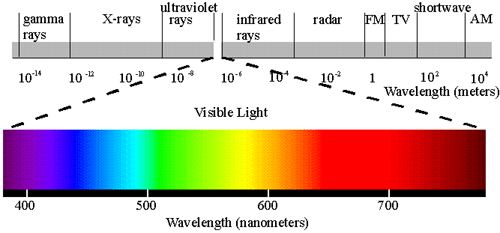
Spectral power distribution graphs show the relative power of wavelengths across the visible spectrum for a given light source. These graphs also reveal the ability of a light source to render all, or, selected colors.
Below
see how a typical spectral power distribution graph for daylight.
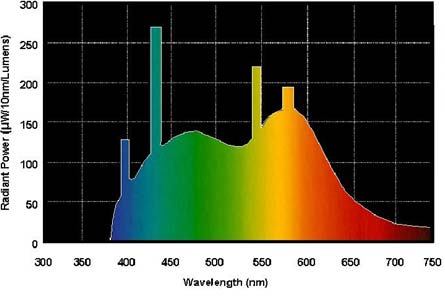
Notice the strong presence (high relative power) of ALL wavelengths (or the "full color spectrum"). Daylight provides the highest level of color rendering across the spectrum.
Compare
the daylight spectral power distribution with that for a particular fluorescent
lamp.
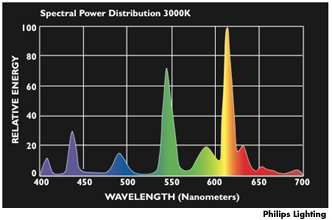
The
most obvious difference is the generally lower level of relative power compared
to daylight - - except for a few spikes. All wavelengths (the "full
spectrum) are again present but only certain wavelengths (the spikes) are
strongly present. These spikes indicate which parts of the color spectrum will
be emphasized in the rendering of color for objects illuminated by the light
source. This lamp has a 3000K color temperature and a CRI of 82. It produces a
light that is perceived as "warmer" than daylight (3000K vs. 5000K).
It's ability to render color across the spectrum is not bad, but certainly much
worse than daylight. Notice the deep troughs where the curve almost reaches
zero relative power at certain wavelengths.
Here
is another fluorescent lamp.
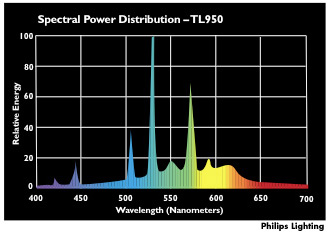
This spectral power distribution looks generally similar to the one above except it shows more power at the blue end of the spectrum and less at the red end. Also, there are no low points in the curve that come close to zero power. This lamp has a 5000K color temperature and a CRI of 98. It produces light that is perceived as bluish white (similar to daylight) and it does an excellent job of rendering colors across the spectrum.
If
you want a high color rendering bulb to produce light perceived as warm white,
choose a bulb with a color temperature of 3000K or 3500K. If you want a high
color rendering bulb to produce light perceived as white, choose a bulb with a
color temperature of 4000K. For a bulb that simulates daylight, choose a color
temperature of 5000K or higher.
What is IP Rating's?
The Ingress protection system is an international standard and allows you to easily see how resistant a product is to different environmental elements.
This system uses a two digit code to specify the degree of particle and water resistance of a luminary, the first digit indicates the degree of protection of the interior from the ingress of solid foreign objects, the second digit indicates the degree of protection of the interior from the ingress of water.
|
First number |
Definition |
Second number |
Definition |
|
0 |
No protection |
0 |
No protection |
|
1 |
Protected against solids objects over |
1 |
Protected against vertically falling drops of water |
|
2 |
Protected against solids objects over |
2 |
Protected against direct sprays up to15°from the vertical |
|
3 |
Protected against solids objects over |
3 |
Protected against direct sprays up to 60°from the vertical |
|
4 |
Protected against solids objects over |
4 |
Protected against sprats from all directions-limited ingress permitted |
|
5 |
Protected against dust-limited ingress (NO harmful deposit) |
5 |
Protected against low pressure jets if water from all directions- limited ingress permitted |
|
6 |
Totally protested against dust |
6 |
Protected against strong jets of water e.g. for use on ship decks - limited ingress permitted |
|
|
|
7 |
Protected against the effects of temporary immersion between |
|
|
|
8 |
Protected against long periods of immersion under pressure |
eg.IP67 means totally protested aganist dust, and the effects of temporary immersion between 15 and


 Deutsch
 Español
 Français
 Italiano
 Português
 日本の
日本の 한국어
한국어 العربية
 български
 hrvatski
 česky
česky Dansk
Dansk Nederlands
 suomi
suomi Ελληνικά
 हिन्दी
 norsk
norsk Polski
 Română
 русский
 Svenska
 中文
中文


